Showing posts with label Tyre. Show all posts

Thursday, 31 January 2013

Hankook Tire: The Future of Tyre Design [Video]


Hankook Tire held a competition in the U.S.A. challenging the "brightest industrial design students" to display how they envision the future of tyres in several types of vehicles. and what we get is some cool looking designs that might actually workd in the real world, we will have to wait and see.


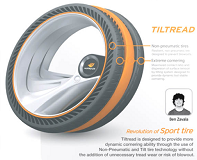
The winning entry by University of Cincinnati student Ben Zavala took the brief somewhat literally, with his Tiltread car tyre rolling into corners at an angle like a motorcycle tyre.

Zavala's breakthrough idea was to split the tyre into three parallel ring sections, each mounted on a corresponding split section of wheel.

As the wheel turns and leans, the three tyre sections are individually raised or lowered, allowing them all to maintain traction with the road surface.

Tiltread's wheels are hubless and contain an electric drive motor which varies power to each tyre section, allowing the sections to spin at different rates during cornering.

University of Cincinnati associate professor Ralph Zammit said the competition demonstrated just how great an impact improvement in tyre design could have upon the overall efficiency, ecology and economy of road transportation.

"Hankook proposed a very challenging assignment that provided the students with real-world insights as to how tyres are currently designed, manufactured and the performance issues they must address," said associate professor Zammit.

"Students were especially encouraged to consider sustainability needs such as reducing and reusing raw materials."

Second place in the competition was taken by Mark Hearn who imagined an off-road tyre called Motiv, which features numerous height-variable, non-pneumatic tread blocks that can adapt to extremely rough terrain without risk of blow-out.

Third-placed Miranda Steinhauser's proposal for an eco-friendly tyre also impressed the competition judges.

The Tessela tyre's easily removable tread components allow consumers to replace worn-out tread when required, rather than the whole tyre carcass, reducing tyre waste and landfill.

Models of the first, second and third placed tyres were displayed on the Hankook stand at the 2012 SEMA automotive show in Las Vegas.

Friday, 4 January 2013

Short News: Colored tires serve as a warning to drivers


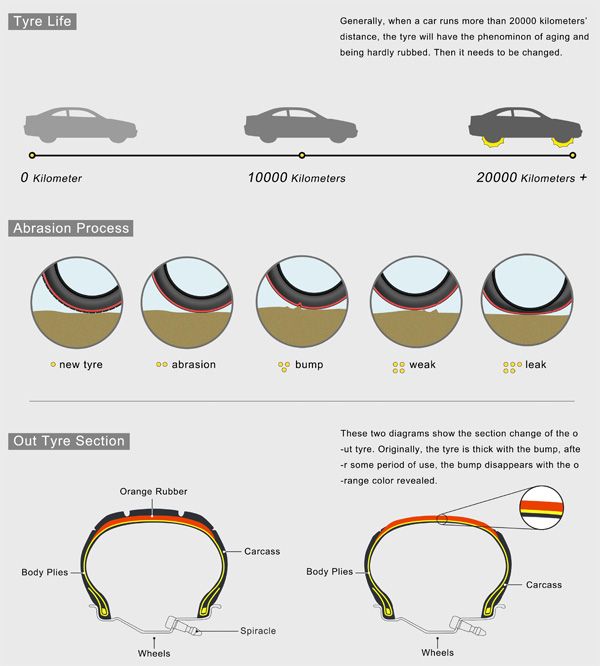
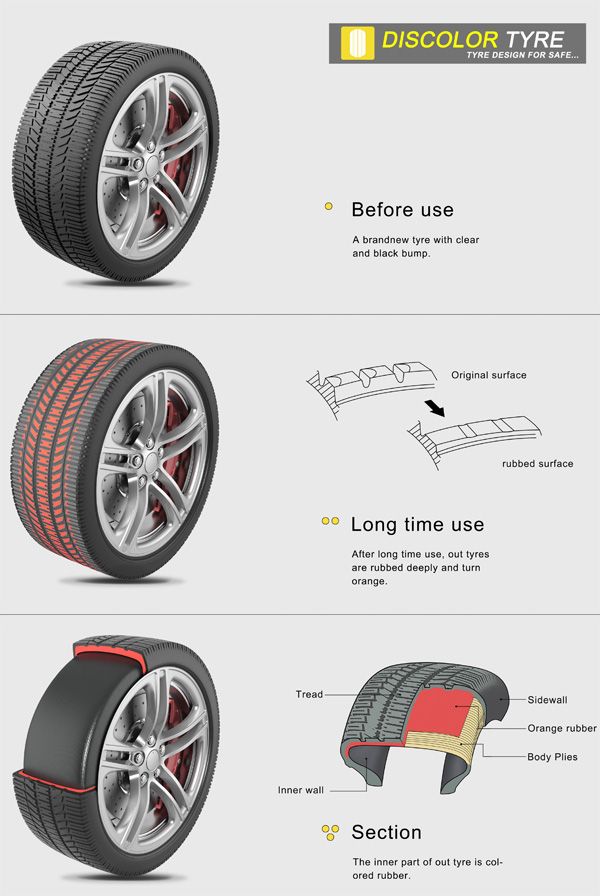
Many drivers ignore the tire conditions until it is too late, others simply do not realize their true state, but now there is a solution. The Discolor Tire.


The operating principle is very simple, after approximately 20.000km (12.427miles) the tires have experienced increased wear, and with the wear begins to appear a colored rubber which was inside the normal black layer. This colored layer is made of a special orange rubber and serves as a warning to the driver that it is time to change the tires.

Source: Yankodesign

The Discolor Tyre is a 2012 iF Design Talents entry. Designers: Gao Fenglin & Zhou Buyi

Friday, 2 November 2012

Tyre labelling system now effective in Europe


Starting from November 1st a new European Union regulation takes effect forcing manufacturers to label their tires with information about fuel efficiency, braking in wet roads and the external rolling noise they make. The label, ranked from A (best) to G (worst), will help consumers make better choices when the time arrives to change rubber.


Commissioner Piebalgs said in 2009 that "This is a typical win-win situation where consumers and fleet managers will be able to choose safer and low noise tyres and save on their fuel bills while the European Union as a whole will benefit from reduced road transport emissions." and "Today's technology makes it possible to significantly reduce the tyre share in vehicle fuel consumption allowing a driver to reduce his/her fuel bill by up to 10% between the best and the worst set of tyres available on the market."


Fuel consumption is related to the rolling resistance. By reducing rolling resistance, the tyre consumes less petrol.


Wet grip is one of the most important safety characteristics of a tyre. Tyres with very good wet grip have a shorter braking distance when it rains.


The external noise generated by the tyre is expressed in waves: one black wave is the lowest noise level and three the highest. The aim is to reduce traffic-related noise for communities.

The European Comission also gives three examples on savings you can have if you choose a better tyre.

If you drive a typical passenger car travelling 25000 km per year (10000 km urban, 15000 km inter-urban), you can save fuel costs between €170–€230 per year. As the best performing tyres will be more costly (additional €240–€320), it is in the second year that you will have net savings – between €100 – 140.

If you drive a big passenger car (consumption of 10lit/100km) with high usage (10000 km urban and 25000 km highway per year), you can save even more fuel costs: €450 per year. As the best tyres will be more expensive (additional €240-€320), you will save between €130 and 210 already in the first year.

If you drive a van, used by companies for delivery and transport, which travels 40000 km per year (20000 km urban, 20000 km inter-urban), fuel costs reductions between €290–€360 per year can be achieved. With additional tyres costs of €280–€360, break-even point is already within the course of the first year.

Source: Michelin and European Comission

 
//PART 2