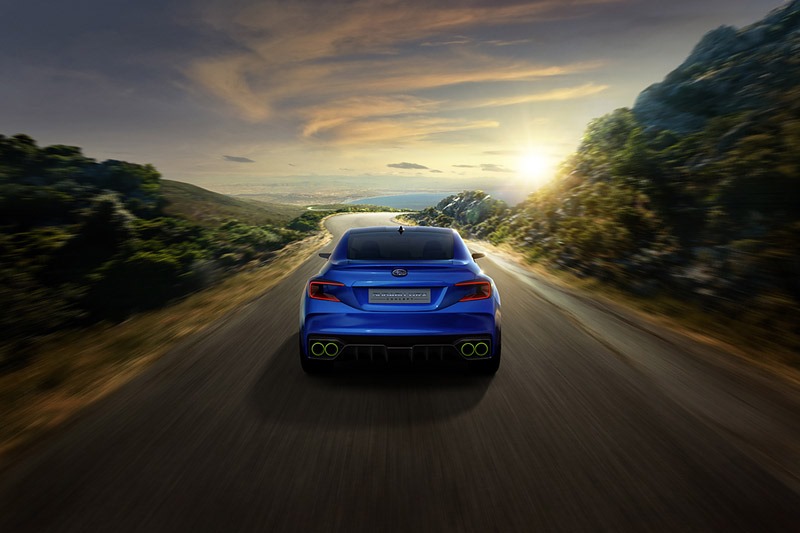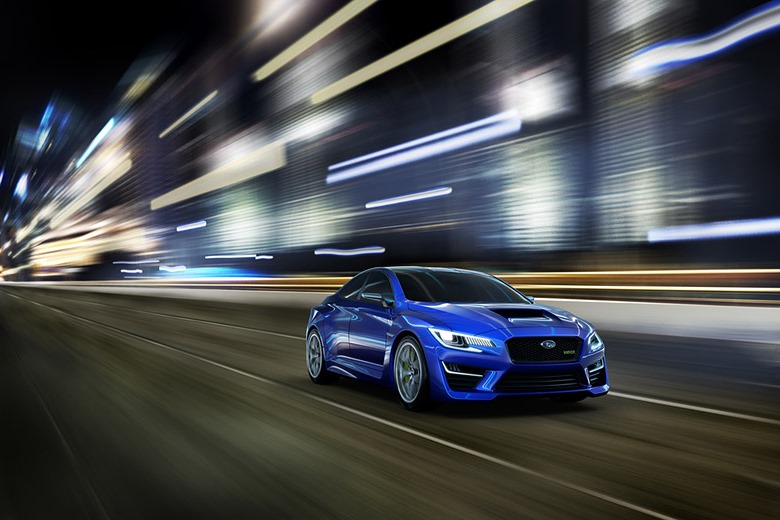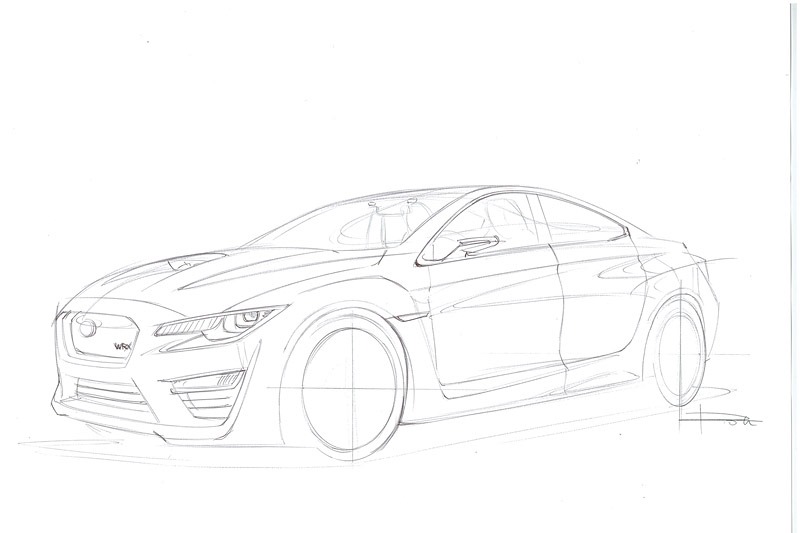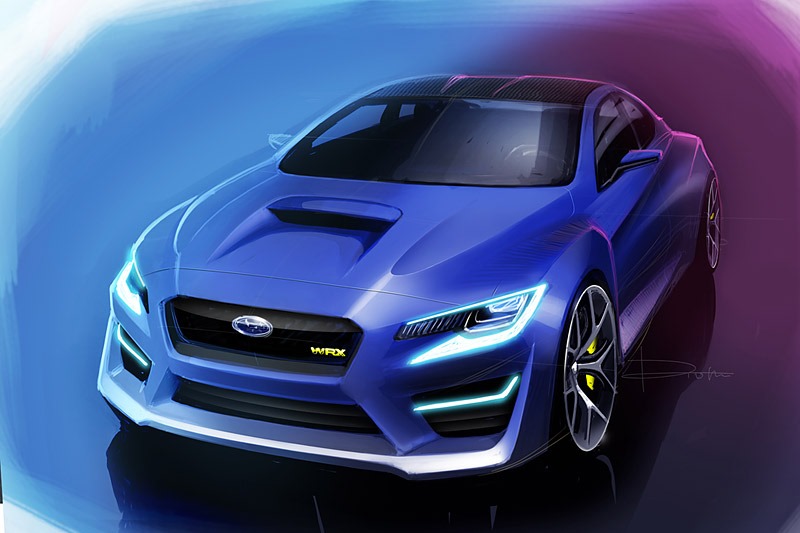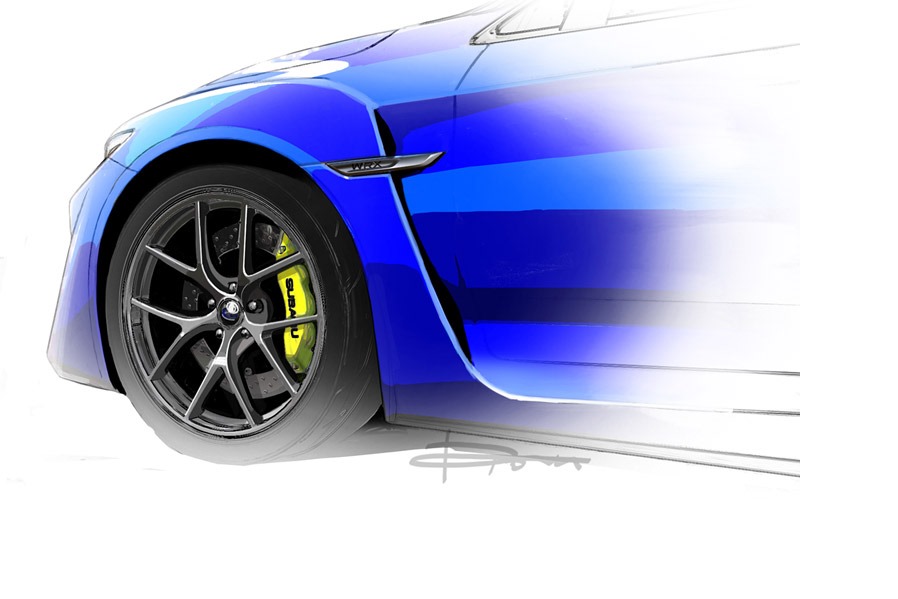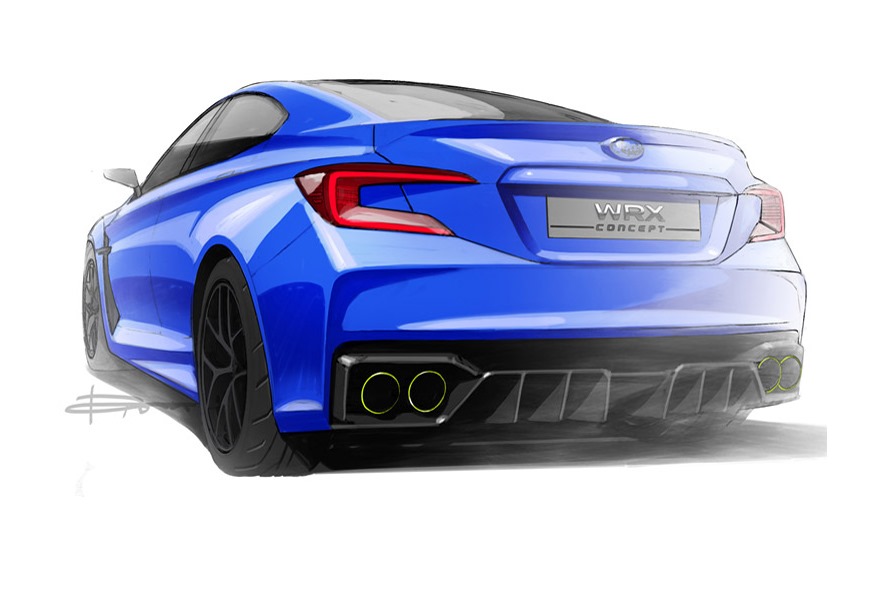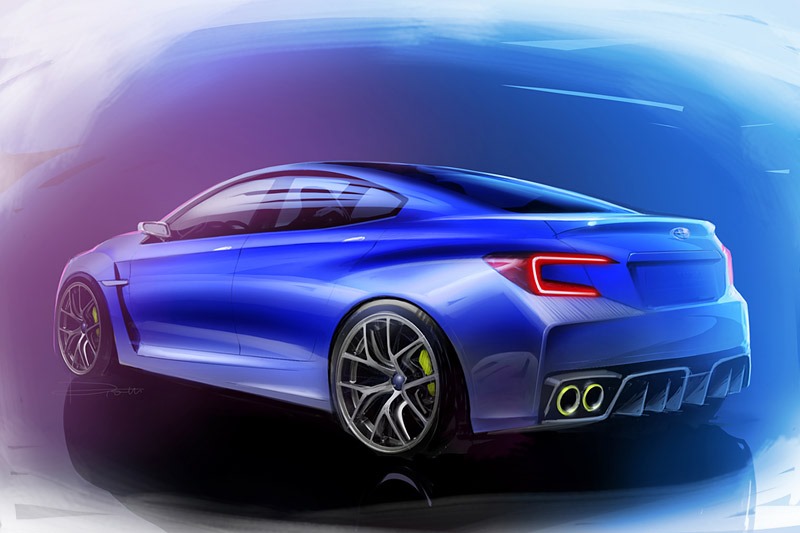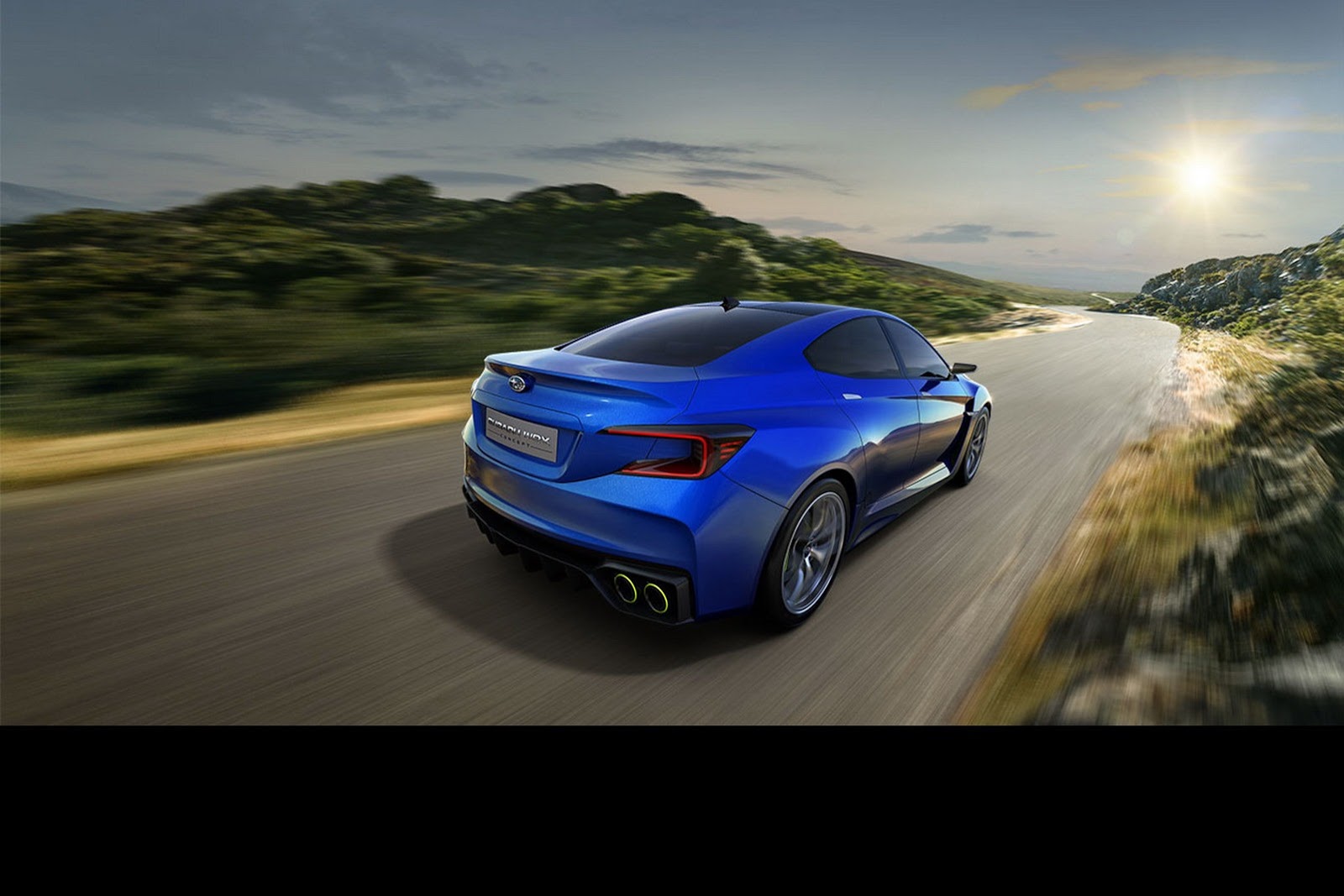
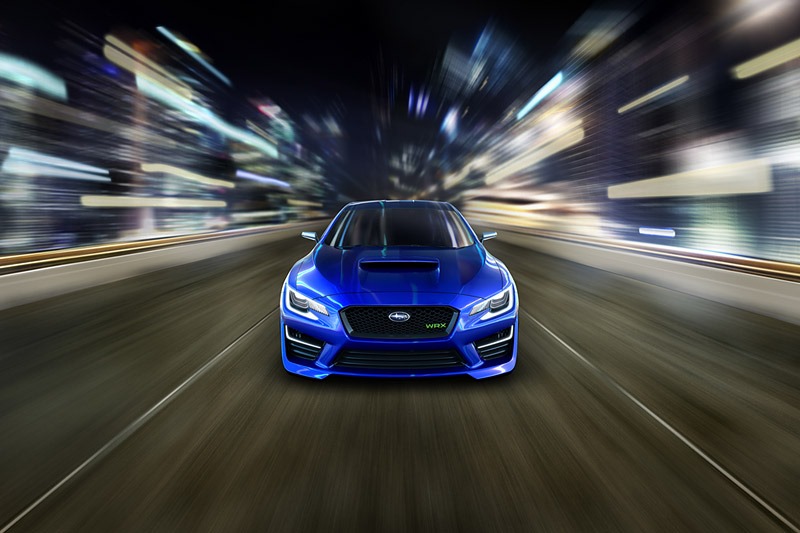
 Subaru of America, Inc. unveiled the Subaru WRX Concept at the 2013 New York International Auto Show at the Jacob K. Javits Center. The design concept hints at the design language of the next generation WRX.
The bold and muscular design emphasizes turbocharged power and AWD grip in a more agile and athletic form. The Subaru WRX Concept blends the WRX's famous power and road-holding prowess with an even greater focus on sharp handling, steering and communicative chassis. To further improve handling dynamics, the Subaru WRX Concept features a carbon-fiber roof to enhance the already low center of gravity and reduce weight.
Considerably lower, sleeker and wider, the Subaru WRX Concept delivers even more street presence than previous generations of WRX. The new grille design is larger and bolder and sets off the classic WRX hood scoop. A pronounced powerbulge provides clearance for the new turbocharged engine and intercooler. A prominent hexagonal grille form and deep lower valences with air intakes are designed to enhance aerodynamics, add downforce and aid engine cooling.
The three dimensional mesh pattern of the grille denotes the sporting nature of the Subaru WRX Concept and sets the Subaru star cluster apart, while the new hawk-eye headlights integrate the Subaru family design heritage.
A sharp character line runs from the front corner through to the taillights, intersected by the boldly flared wheel arches emphasizing the Subaru's AWD system. The compact cabin greenhouse draws attention to the power and solidity of the body and focuses attention to wide stance that provides a visual link between body and chassis.
The rear design echoes the hexagonal design motif from the front grille and features a dramatically curved trunk lid that also acts as a rear spoiler. The distinctive wide rear bumper of the Subaru WRX Concept adds to the powerful street presence of the car and is off-set by large quad tailpipes denoting the powerful turbocharged engine. The aggressive rear diffuser improves vehicles aerodynamics.
The all-new Subaru WRX Concept features a new paint color, "WR Blue Pearl III", which modernizes the iconic WRX look. Fluorescent Yellow is used as an accent on the WRX badge on the front grille, the brake calipers and the exhaust tip finishers, adding character notes to the design.
Filling out the broad fenders are BBS "RI-D" One Piece Forged Duralumin wheels and featuring 245/40ZR20 Dunlop tires with an exclusive tread pattern.

(SEOUL) March 28, 2013 – Kia Motors sprang a major surprise on visitors to the 9th Seoul International Motor Show today (Thursday) in Korea with the world premiere of its all-new ‘CUB’ concept.
Designed at the Kia headquarters studio in Seoul, under the direction of President and Chief Design Officer, Peter Schreyer, the CUB is less than four meters long, has rearward-opening rear doors and an ‘access-all-areas’ interior concept without traditional B-pillars, providing excellent access to the luxuriously trimmed cabin.
“The new Kia CUB is a compact, four-door coupe created with a clear focus on driving performance and practicality,” comments Thomas Oh, Senior Executive Vice President and COO, Kia Motors Corporation. “Styled to appeal to trend-setting urban dwellers, the CUB features a comfortable four-seater cabin which generates an emotional, feel-good response and delivers everyday, real-world benefits.”


The exterior styling of the CUB highlights that it is both sleek and small, with a cheerful face and a daring character. Design features created by Peter Schreyer for the 2007 Kia Kee 2+2 concept are revisited in a new form. The CUB’s nose has a broad wrap-around ‘mouth’ and there is a ‘dip’ in the top of the windshield – a motif that is featured on Optima, Sportage and Cadenza models. The latest interpretation of grille is a shallower design incorporating the turbocharger’s air intake, highlighted in body color.
The headlamps feature two-point LED lights – similar to those which first appeared on the Kia Quoris large flagship sedan last year. Large 19-inch alloy wheels fill the wheelarches and the front doors have aerodynamic ‘turning-vanes’ at sill level to streamline and add definition the CUB’s flanks.

At the rear, LED tail lights complete the premium feel of the exterior and the nose treatment derived from Kia’s Kee concept car is replicated at the tail to accentuate the width of the vehicle.
The super-smooth exterior, with its flush glazing, minimum-drag wing mirrors and automatic touch-type door handles, promises ultra-low aerodynamic drag. A two-color paint finish with sporty stripe hints at the CUB’s high-performance potential, while the car’s broad track gives it an imposing stance.

Four-seater luxury cabin
With four individual seats, the CUB’s interior presents a unique ambience. The cabin creates the sensation of a luxurious coupe and is trimmed in black leather with yellow color accents around the seats, door armrests and steering wheel.
The instrument cluster design is inspired by the eyes of a wild animal. The center-stack design is minimalist with an air vent controlled by touch sensor. For extra safety, the steering wheel rim is capable of monitoring the driver's biorhythms.
As well as a steering-wheel, there is a DIS (Driving Information System) controller connected to a gesture camera which provides easier operation while driving. With well-defined motions, drivers can set up each menu on the center display. Hinting at the high-performance nature of the CUB, there is a footrest provided in the front passenger footwell.

Turbocharged 204 ps engine
The CUB powertrain features a new version of the company’s 1.6-liter GDI (gasoline direct injection) engine – recently confirmed as the powerunit for the new Kia pro_cee’d GT and cee’d GT sold in Europe.
Fitted with a twin-scroll turbocharger and strengthened internal components, the new engine generates 51% more power (204 ps) and 60% more torque (265 Nm) than the regular 1.6 unit. This engine enables both of Kia’s European GT models, with a six-speed manual transmission, to accelerate to 100 kph in 7.7 seconds and reach a top speed of 230 kph.
At present there are no plans to put the Kia CUB concept into volume production.

 March 28, 2013 – Hyundai Motor Co., the fastest-growing automaker by brand, today staged a world-premiere of the HND-9, its latest luxury sports coupe concept that illustrates the company’s future design direction.
“HND-9 will give customers a glimpse of Hyundai’s future luxury sports coupe models,” said Suk-Geun Oh, head of Hyundai Design Center. “Representing an evolution of Hyundai’s ‘Fluidic Sculpture’ design philosophy, the rear-wheel drive sports coupe concept balances high performance with a sophisticated image.” The concept was unveiled at the 2013 Seoul Motor Show.
The HND-9 is the ninth concept model developed by the Hyundai Motor Group’s R&D Center in Namyang, Korea. Based on a modern reinterpretation of an elegant, classic premium sports coupe, sophisticated details in every design element of the car reinforce a premium look. The vehicle, with its dramatic, long hood and wheelbase, has an overall length of 4,695mm, width of 1,890mm and height of 1,340mm with a 2,860mm wheelbase.
Equipped with 3.3-liter turbo GDi engine and 8-speed auto transmission, HND-9 delivers a maximum output of 370ps, while its exterior design exudes a befitting image of the powerful performance.


Fluidic yet sleek character lines that stretch from headlamp to trunk, voluminous, powerful car body and a striking, wide hexagonal-shaped radiator grille enhance the vehicle’s high performance image.
Moreover, butterfly doors, sculptural rear combination lamps, and dual tailpipes placed on both sides, give the car a sleek, futuristic look. Twenty-two inch alloy wheels – mixed with carbon materials - also contribute to great styling, while lowering its weight.
Like its exterior, the interior styling of the HND-9 was designed to deliver a modern, luxurious driving experience. Three key concepts were embedded into the interior design to realize this goal: spiral sculpture, elegance and high-tech interface.
Based on the spiral sculpture concept - derived from Hyundai’s Fluidic Sculpture design philosophy - dynamic and distinctive spiral-shaped metal lines frame the entire interior in a speedy and rhythmical way, creating a unique layout.
The seats are made of sporty yet luxurious mesh, and depending on which angle they are seen from, they project different colors, exuding elegance and mystique. The driver-oriented, high-tech interface is modeled after a cockpit, offering both improved functionality and aesthetics, optimized for dynamic driving.


2014 Camaro Z/28 the Most Track-capable Camaro Ever
NEW YORK – Chevrolet today introduced the restyled 2014 Camaro line at the New York Auto Show, including the return of the Z/28, the most iconic model in Camaro history.
The 2014 Camaro models feature a revised exterior design that integrates high-performance aerodynamics for more efficient cooling and stability at high speeds. The new Camaro Z/28 also features a full aerodynamics package that creates downforce at speed, which helps make it the most track-capable offering in Camaro’s history.

“As the ultimate track-capable Camaro, this car restores the mission of the original Z/28, and serves as a testament to the expertise of Chevrolet as the best-selling brand of performance cars,” said Mark Reuss, president, GM North America. “The build sheet is the wish list of any racer: lightweight, high-revving, dry-sump LS7 engine; carbon-ceramic brakes; integrated coolers for track use; true aerodynamic downforce, and a significant reduction in curb weight. This car could only come from Chevrolet, and could only be called the Z/28.”
The first Camaro Z/28 was introduced in 1967, created to compete in the Sports Car Club of America's Trans-Am 2 class. It featured a smaller, lighter, 302-cubic-inch V-8 for improved weight balance, as well as quick-ratio steering and a heavy-duty suspension for track use. In keeping with its road-racing focus, the 1967 Camaro Z/28 was not available with an automatic transmission or air conditioning.
While the new Camaro Z/28 is not intended to compete in a specific race series, it is solely focused on track capability. In initial testing, the Camaro Z/28 is three seconds faster per lap than the Camaro ZL1. That extra speed comes from three areas:
Increased grip: The Z/28 is capable of 1.05 g in cornering acceleration, due to comprehensive chassis revisions
Increased stopping power: the Z/28 features Brembo carbon-ceramic brakes capable of 1.5 g in deceleration, and consistent brake feel, lap after lap
Reduced curb weight: The naturally aspirated Z/28 weighs 300 pounds less than the supercharged Camaro ZL1, with changes ranging from lightweight wheels to thinner rear-window glass
Like the original, the 2014 Camaro Z/28 is offered only with a manual transmission. In a nod to modern convenience, air-conditioning is available, but only as an option.
"We set out to make the fastest road-racing Camaro possible that was still street-legal,” said Al Oppenheiser, Camaro chief engineer. “While the Camaro ZL1 offers exceptional performance on the street, the drag strip, and the track, the Z/28 is entirely focused on the track performance. The Z/28 will be too track-focused for most drivers, but offers road-racers one of the most capable track cars ever offered from an automaker.”
The new 2014 Camaro line will arrive at Chevrolet dealers later in 2013. The Camaro Z/28 is expected to be appearing at track events across the United States in spring 2014.
High-performance aerodynamics highlight changes for 2014 Camaro
The 2014 Camaro represents the most significant redesign since the introduction of the fifth-generation Camaro as a concept car in 2006.
“The 2014 Camaro is our opportunity to apply what we have learned listening to our customers, and our continuing development of high-performance models,” said Tom Peters, Camaro exterior design director. “We look for solutions that are both functional and beautiful so that the result is genuine Chevrolet – simple, powerful, honest, and more than expected.”
Compared to the previous model, the design represents a strong visual change front and rear, resulting in a wider, lower, more contemporary appearance. The front fascia features a wider lower opening, and a narrower upper opening that also updates the appearance of the iconic “halo ring” HID headlamps on the Camaro RS package. The functional hood vent on the Camaro SS helps reduce heat and aerodynamic lift. Moving to the rear, the sculptural decklid, horizontal lamps and diffuser complete the powerful statement.
The Camaro Z/28 also features a full aerodynamic package designed to produce downforce at track speeds. At the front, the Z/28 features a large splitter, connected to an underbody panel that further reduces lift. In profile, the Z/28 features fender flares over the front and rear wheels, as well as extended rocker panels that contribute to aerodynamic stability. An aggressive rear spoiler and functional diffuser complete the aerodynamic package.
On the interior, the Camaro Z/28 features trim in a distinctive, matte-metallic finish named Octane, the ZL1 flat-bottomed steering wheel, and standard Recaro seats with microfiber suede inserts. The new seats (also available on the coupe versions of the SS and ZL1 models), feature aggressive bolsters for high-performance driving, as well as seat cutouts inspired by the five-point harnesses found on racing seats. To save weight, both front seats incorporate manual adjustment.
The rear seats of the Z/28 have also been modified for weight reduction. A total of nine pounds (four kilograms) was saved by eliminating the seat-back pass through, as well as using high-density foam in place of the rigid structure of the seat back and steel mesh of the seat bottom.
“Unlike the Ford Mustang Boss 302, we felt it was important to keep the 2+2 configuration of the Camaro Z/28 as Chevrolet already has a world-class two-seat sports car in the Corvette,” said Oppenheiser. “By modifying the construction of the rear seat, we were able to reduce the overall weight of the Z/28 while still preserving the flexibility of 2+2 seating.”
7.0L, LS7 the heart of the Camaro Z/28’s track-capable performance
Like the original, the new Camaro Z/28 forgoes ultimate horsepower and torque for improved weight balance and track performance.
In 1967, the most-powerful engine available in a factory Camaro was a 396 cid V-8 with 375 horsepower. To prepare the Camaro Z/28 for road racing, engineers specified a lighter, 302 cid V-8, officially rated at 290 horsepower. While the 302 was not the choice for drag racers, it proved ideal for sports-car racing.
Today, the most-powerful engine offered is the Camaro ZL1’s supercharged 6.2L LSA, which delivers 580 horsepower. The heart of the 2014 Camaro Z/28 is the lighter, naturally aspirated 7.0L LS7 first introduced in the Corvette Z06.
“The LS7 is ideal for road racing because it delivers amazing performance in a compact, lightweight package,” said Jordan Lee, Small Block chief engineer and program manager. “The broad torque curve and high redline of the LS7 mean fewer shifts are required for each lap, while the lightweight design improves the front-to-rear weight balance for better handling.”

Co-developed with Corvette Racing, the hand-assembled 7.0L (427 cid) V-8 uses a number of high-performance components, including:
Titanium intake valves and connecting rods, and sodium-filled exhaust valves
CNC-ported aluminum cylinder heads
Forged-steel crankshaft and main bearing caps
High-lift camshaft
Hydroformed exhaust headers
11.0:1 compression ratio, and a 7,000 rpm redline.
10.5-quart, dry-sump oiling system
For the Camaro Z/28, the LS7 features unique induction and exhaust systems, and delivers at least 500 horsepower (373 kW) and 470 lb-ft of torque (637 Nm).
The racing-style, cold-air induction system and large K&N air filter provide maximum air flow.
The standard dual mode exhaust system and larger-diameter pipes enable improved air flow. By bypassing the mufflers during acceleration, the system increases both the torque and sound generated by the LS7 engine.
The Camaro Z/28 is exclusively offered with a Tremec TR6060 manual transmission. The six-speed features close-ratio gearing and 3.91:1 final drive ratio, both optimized for the power characteristics of the LS7.
Power is distributed to the rear wheels via a limited-slip differential featuring a helical gear set, rather than traditional clutch packs. The new design enables the driver to apply more power and get through corners faster, by continuously adjusting the torque bias to maximize available traction.
The differential works in unison with Chevrolet’s proprietary Performance Traction Management system, which allows drivers to adjust the level of throttle and brake intervention to match their capability and driving environment.
Unlike some competitors’ “track package” offerings, the Camaro Z/28 makes standard all the cooling systems required for track use. This includes the dry-sump oiling system for the LS7, which is connected to an integral liquid-to-liquid cooling system for engine oil.
A second liquid-to-liquid system provides cooling for the transmission and differential. This system pumps overcooled transmission fluid to a heat exchanger in the rear differential before traveling to the transmission. This reduces differential temperatures as much as 100 degrees F.
Camaro Z/28 chassis delivers 1.05 g in cornering grip
The singular focus of the Camaro Z/28 is most evident in the chassis, where the most has been made of every component for track use, from the ultra-high performance tires to race-proven dampers.
“We used the very best components in the industry to deliver uncompromised performance, lap after lap,” said Mark Stielow, Camaro Z/28 engineering manager. “We made nearly 200 changes to improve the track performance, which cumulatively make the Z/28 capable of 1.05 g in cornering. For perspective, with all other things, equal increasing maximum grip from 1 to 1.05 g can cut up to four seconds per lap.”
The Camaro Z/28 is the one of the first production cars fitted with race-proven, spool-valve dampers. Compared to a conventional damper that offers only two-way tuning for bump and rebound, a spool-valve damper allows four-way adjustment to precisely tune both bump and rebound settings for high-speed and low-speed wheel motions. The wider tuning range allowed engineers to dramatically increase the damper stiffness on the Camaro Z/28 without a significant change in ride quality. Additional chassis changes include stiffer string rates and suspension bushings for improved cornering response.
The Camaro Z/28 features 19-inch diameter wheels and tires, which reduce unsprung weight by 42 pounds (19 kilograms) per car compared to the 20-inch wheels standard on Camaro SS and ZL1. In addition, the smaller diameter wheels lower the center of gravity by 33 millimeters, further improving handling.
At all four corners, the lightweight, forged aluminum wheels are wrapped in massive 305/30ZR19 tires. This is the first production application of ultra-high performance Pirelli PZero Trofeo R tires, and believed to be the widest front tire on any production car.
To fully exploit the grip of the Pirelli tires, the Camaro Z/28 also features Brembo Carbon Ceramic Matrix™ rotors and fixed, monoblock calipers. The large 394 x 36 mm front rotors are paired with six-piston calipers, while the 390 x 32 mm rear rotors are paired four-piston calipers. Compared to similar-size, two-piece steel rotors, the lightweight carbon discs save 28 pounds (12.5 kilograms) per car.
The combination of tire grip and braking power enable the Camaro Z/28 to achieve up to 1.5 g in deceleration. With standard front brake cooling ducts, the Z/28 is also capable of continuous track use unmatched brake feel, lap after lap.
“What makes the Z/28 so addictive is it inspires confidence through every section on the track,” said Stielow. “The incredible, balanced performance helps you carry much more speed through every corner: the brakes are so good you can adjust your braking points later and later; the grip and suspension damping allows you to carry more speed through the apex; and then the limited slip allows you to make the most of the LS7 as you power out of the corner.”
Extensive lightweighting saved 300 pounds over the Camaro ZL1
To optimize the track performance of the Camaro Z/28, the engineering team subjected it to an intensive lightweighting program, saving 100 pounds (45 kilograms) compared to the naturally aspirated Camaro SS and 300 pounds (136 kilograms) to the supercharged Camaro ZL1.
“We looked at every subsystem for opportunities to save weight,” said Oppenheiser. “Our goal was to get rid of everything that didn’t make the car faster, and keep only what was required by law. For example, we wanted to eliminate the audio system completely, but we had to keep a single speaker for the seat-belt chime to meet safety requirements.”
Other examples of weight savings include:
Eliminated the tire-inflator kit, except for Rhode Island and New Hampshire, where it is required by law
Removed interior sound deadener, and carpeting from the trunk
Replaced the standard LN4 battery with a smaller, lightweight, LN3 battery
Specified thinner, 3.2-mm glass for the rear window, compared to 3.5-mm glass on the standard Camaro
HID headlamps and foglights are not available
Air conditioning is only available as a stand-alone option
“The team was so fanatical about saving weight, we even stripped the unused wiring out of the harness when we eliminated the fog lights, speakers, and air conditioning,” said Oppenheiser. “Every ounce saved contributed to making this the most track-capable Camaro we have ever built, and a worthy successor to the Z/28 name.”
 Acura unveiled the all-new 2014 MDX luxury SUV at the 2013 New York International Auto Show (NYIAS). Built on a completely new platform, the seven-passenger MDX offers improved ride comfort, a more versatile and luxurious cabin, increased fuel efficiency and enhanced dynamic performance. The MDX will also be offered for the first time in a more affordable and even more fuel-efficient two-wheel-drive configuration.
"Building on the award-winning dynamic performance of the previous model, the third-generation Acura MDX adds new levels of luxury comfort, family functionality and fuel efficiency to once again set the luxury SUV benchmark," said Jeff Conrad, vice president and general manager of Acura Sales. "From Nürburgring-tuned dynamics and thoughtful interior appointments, to the addition of a new two-wheel-drive model, the all-new MDX continues Acura's direction of creating vehicles that advance the synergy between man and machine."
Powertrain
The 2014 Acura MDX is powered by an all-new direct-injected 24-valve 3.5-liter i-VTEC V-6 engine with Variable Cylinder Management™ (VCM™), producing 290 horsepower and 267 lb.-ft. of torque. The MDX's engine architecture is shared with two racecars that recently finished First and Second in the LMP2 class at the 12 Hours of Sebring endurance race in the American Le Mans Series (ALMS). Employing a 6-speed automatic transmission with Sport Mode and Sequential SportShift Paddle Shifters, the new Acura MDX will be offered in both Super Handling All-Wheel Drive™ (SH-AWD™) and two-wheel-drive drivetrain variants, both featuring Acura's new Agile Handling Assist technology.
Matched to the highly efficient Earth Dreams Technology engine and the SH-AWD drivetrain, the 2014 MDX has an EPA fuel economy rating of 18/27/21 mpg (city/highway/combined), while the new front-wheel-drive model is EPA rated at 20/28/23 mpg (city/highway/combined).
While achieving even higher fuel economy ratings, the MDX remains a true driver's SUV with enhanced dynamic performance, including quicker acceleration, more responsive braking and even more precise steering feel. Tuned and tested on the grueling Nürburgring racing circuit in Germany, the lighter and more dynamic new 2014 MDX with SH-AWD bests the previous model's lap time by eight seconds.
To satisfy the preferences of multiple drivers in any family, the 2014 MDX features an all-new Integrated Dynamic System (IDS) with three modes: Sport, Normal and Comfort. IDS adjusts steering effort, throttle response, SH-AWD and active sound to suit the tastes of the driver. The Acura MDX's new Amplitude Reactive Dampers, MacPherson strut front suspension and new multi-link rear suspension enable its more nimble and responsive handling and improved ride quality. 18-inch aluminum alloy wheels and 245/60-18 tires come standard on the MDX. Technology and Advance grades are equipped with 19-inch aluminum alloy wheels and 245/55-19 tires.

Body and Styling
The 2014 MDX body applies more than 55 percent advanced lightweight materials - including high strength steel, aluminum and magnesium - resulting in a vehicle that is both more rigid and lightweight, with total vehicle weight reduced 275 pounds from the previous model. Measuring 193.6 inches in overall length, 77.2 inches in overall width (excluding door mirrors), 67.6 inches in overall height, and riding on a 111-inch wheelbase (up 2.75 inches from the previous model), the new MDX boasts an "Executive Aero Sculpture" exterior design that lends it a sleek, tailored and sophisticated appearance. The aerodynamic body design - refined by engineers in a new wind tunnel at the company's Ohio R&D center - helps the MDX achieve a more than 17 percent improvement in aerodynamic efficiency, making it one of the most aerodynamic and fuel-efficient luxury SUVs on the road.
The 2014 Acura MDX also takes a big step up in luxury comfort and quiet. The MDX's dynamically tuned platform, more airtight body and triple path isolated dampers, along with the use of new sound-deadening materials, such as acoustic glass and expanding body sealers, and Active Noise Control technology, make this the quietest and most composed MDX yet.


Interior
Equally adept at carrying clients and kids, the new MDX boasts a luxurious and versatile interior. The revised body dimensions and new, more compact multi-link rear suspension, combined with innovative new technologies on the second-row seats, significantly improve third-row access and all-around passenger comfort. Third-row ingress and egress is significantly improved by a two-inch lower step-in height and three-inch wider entryway, and by the introduction of a new One-Touch Walk-In feature. With a single press of the illuminated One-Touch Walk-In button, the second-row seats automatically fold and slide to their forward-most position. The second-row seats now feature a four-position recline and a new Extended Slide capability that provides six inches of total fore-aft seat adjustment for optimal balance between second- and third-row legroom. Rear cargo capacity is also improved and includes a new underfloor storage area.
Up front, there is a 10-way power adjustable and heated driver's seat and an 8-way power and heated passenger seat. The Acura MDX also addresses a major shortcoming of many luxury SUVs - available front-seat storage space - with a spacious new center console that can accommodate a purse, laptop case, or a pair of iPads®. The MDX's luxury quotient is further boosted by its upgraded interior appointments, including premium leather-trimmed interior, silver plated accents, LED overhead and cabin accent lighting, along with new optional luxury features, such as Smart Entry, second-row sunshades, remote engine start, and auto-linked air conditioning and climate-controlled seats.
Acura Signature Technology
In addition, the 2014 Acura MDX harnesses a range of Acura signature technologies, including Acura Jewel Eye™ LED headlights, more powerful Acura/ELS Studio premium audio system, and the next-generation AcuraLink™ connectivity system with AcuraLink Real-Time Traffic™, featuring freeway traffic and surface street conditions (free for the first three years). In addition to the traffic services, the AcuraLink™ cloud-based connected car system offers an assortment of media, convenience, information and security features via an embedded cellular system and compatible web-enabled smartphones.
Both the AcuraLink™ and Acura/ELS Studio system take advantage of a 7-inch color On Demand Multi-Use Display™ (ODMD) touchscreen with haptic feedback and an 8-inch Color Information Display. The addition of the ODMD, along with other interior changes, allowed engineers to reduce the number of hard buttons in the center stack from 41 to just nine. The available Entertainment package adds a DVD Rear Entertainment system with a 9-inch full VGA screen for the rear seats, while the Advance package replaces the 9-inch monitor with an ultra-wide, 16.2-inch full VGA screen with HDMI compatibility for devices such as a game console.
The 2014 MDX offers a host of innovative driver assistive and visibility technologies, including a Multi-Angle Rearview Camera and available Lane Keeping Assist System (LKAS), Adaptive Cruise Control (ACC) with Low-Speed Follow, Blind Spot Information (BSI), and Collision Mitigation Braking System (CMBS).
Safety
The third-generation Acura MDX is expected to achieve top-level safety ratings, including a 5-star Overall Vehicle Score from NHTSA and a TOP SAFETY PICK+ rating from the Insurance Institute for Highway Safety (IIHS), including the highest possible rating of GOOD in the Institute's new small-offset frontal collision test.
The new MDX is equipped with a broad array of advanced safety technologies, including the next generation Advanced Compatibility Engineering™ II (ACE™ II) body structure, 4-wheel Anti-Lock Braking System (ABS) with Electronic Brake Distribution (EBD) and Brake Assist, Vehicle Stability Assist™ (VSA®) with Traction Control, and airbags (front, front side, driver's knee and side curtain with rollover sensor), as well as the available Forward Collision Warning (FCW) and Lane Departure Warning (LDW) systems.
The 2014 Acura MDX is scheduled to go on sale at U.S. Acura dealers nationwide in the summer of 2013 and will be available in four grades - the well-equipped MDX, the robust Acura MDX with Technology package, the rear-passenger-friendly MDX with Technology and Entertainment packages, and the top-of-the-line MDX with Advance and Entertainment packages. The 2014 MDX was designed and developed in the U.S. and will be built at the Lincoln, Alabama plant using domestic and globally sourced parts.